


How to Choose Labels and Thermal Transfer Ribbons for Food Delivery Packaging
Food delivery packaging labels have to remain readable across practical handling conditions such as chilled storage, condensation, transport and short delivery cycles. Buyers also need to match the label surface with the printing method so that product names, dates, barcodes and handling information can be printed clearly. The right solution starts with three decisions: paper or film label material, direct thermal or thermal transfer printing, and the ribbon type used with the selected facestock. This guide explains how to organize those requirements before requesting samples or a quotation.
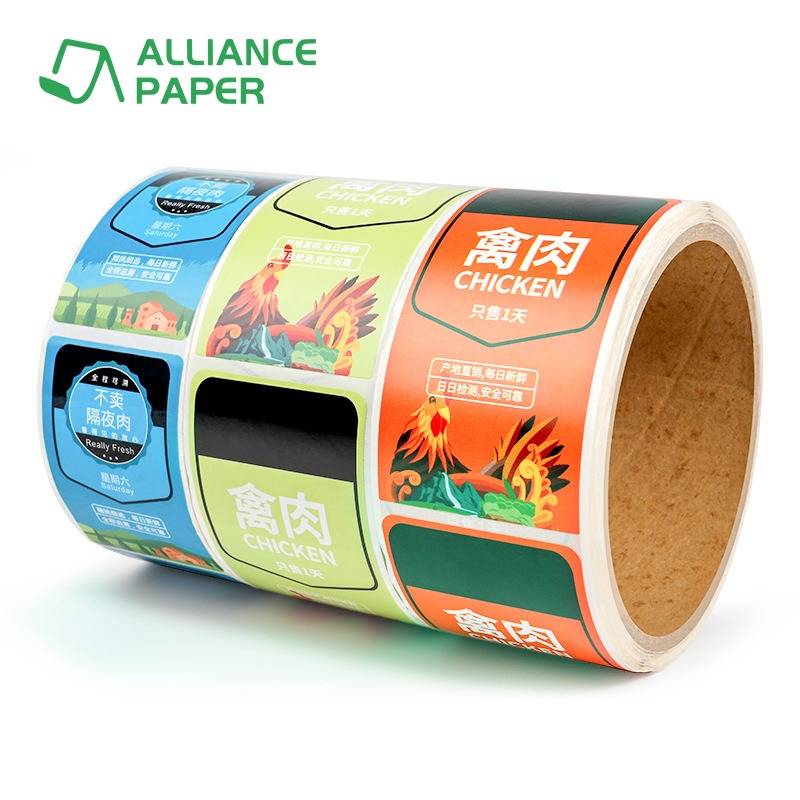
Custom printed label rolls for prepared food packaging applications.
What Conditions Should Food Delivery Packaging Labels Handle?
A label used on the outside of prepared-food or delivery packaging may move between production, storage, transport and customer handling. Instead of selecting material by appearance alone, buyers should describe the actual packaging surface and operating environment.
· Packaging surface: paper box, plastic tray, film bag, cup, bottle or another outer package.
· Environment: room temperature, chilled storage, condensation, moisture or contact with an oily outer surface.
· Handling: manual application, automatic labeling, stacking, transport and short-term storage.
· Printed information: text, production date, barcode, QR code or variable order information.
Performance depends on the complete label construction, including facestock, adhesive, liner, printing method and application conditions. Requirements for direct food contact or local packaging compliance should be reviewed separately for the destination market.
How Do Paper and Film Label Materials Differ?
The first material decision is normally paper versus film. The guide to paper and film label materials provides a broader comparison; for food delivery packaging, the choice should be tied to the package surface, moisture exposure, appearance and printing method.
Semi-Gloss Paper Labels
Semi-gloss paper provides a smooth printable surface and is commonly considered when buyers want a clean printed appearance on paper or suitable plastic packaging. The adhesive and label construction still need to be matched to the actual package and storage conditions.
Synthetic PP Labels
Synthetic PP can be evaluated where a film label is preferred. Buyers should confirm the surface treatment, stiffness, adhesive and printing compatibility rather than treating every PP label as identical.
PET and PVC Labels
PET and PVC materials may be considered for applications requiring a film facestock and a specific balance of clarity, stiffness, flexibility or print durability. Selection should be based on the package shape and the final use environment.
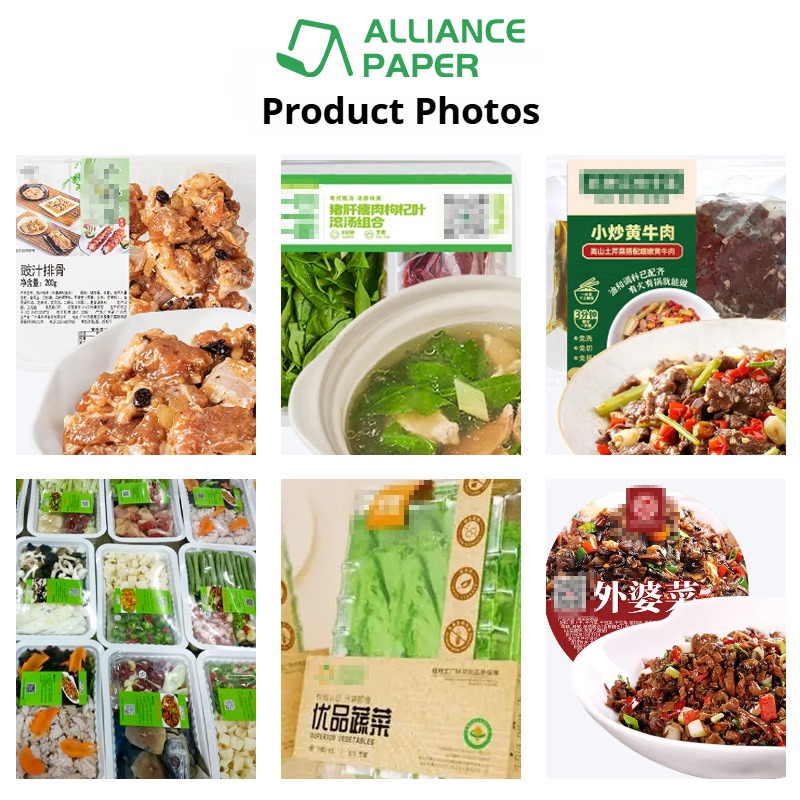
Examples of labels used on prepared and fresh food packaging.
Which Printing Method and Ribbon Should Buyers Consider?
Direct thermal labels form an image through heat and do not require a ribbon. Thermal transfer labels use a ribbon and are selected when the buyer needs to match a ribbon with paper or film facestock. The comparison of direct thermal vs thermal transfer labels can help buyers confirm the printing route before selecting material.
Wax Ribbon for Semi-Gloss Paper
For suitable paper labels, buyers can evaluate a wax ribbon for semi-gloss food packaging labels. The label surface, printer model and settings should be tested together for text and barcode clarity.
Wax/Resin Ribbon for Synthetic PP
Where synthetic PP and stronger print resistance are being considered, a wax resin ribbon for synthetic PP packaging labels may be evaluated. Sample testing should reflect the actual package and handling conditions.
Resin Ribbon for PET and PVC
For PET or PVC label surfaces and applications that require the resistance characteristics associated with resin printing, buyers can evaluate a resin ribbon for PET and PVC packaging labels. The printer, material and ribbon must be treated as a matched system.
What Specifications Should Buyers Confirm Before Ordering?
· Package material and surface condition.
· Label width, height and shape.
· Paper or film facestock requirement.
· Adhesive requirement and application temperature.
· Direct thermal or thermal transfer printing.
· Printer model, sensing method, roll core, outside diameter and winding direction.
· Text, barcode or QR-code printing requirement.
· Order quantity, packing and export destination.
Providing a sample package, existing label or printer information helps reduce mismatches and makes sample evaluation more useful.
How Can Foshan Alliance Paper Support a Label Project?
Foshan Alliance Paper manages coating, printing and slitting processes under one roof. The company supplies raw materials and ready-to-use small rolls, and supports customized printing and formatting based on the buyer's application. For export orders, the team also assists with logistics coordination and export documentation.
Buyers can review the available printer label rolls and submit the package, printer and label requirements for product matching.
Conclusion
Food delivery packaging labels should be selected as a complete system: package surface, label material, adhesive, printing method and ribbon. Clear specifications and sample testing help buyers compare suitable options before placing a production order.
Frequently Asked Questions
Are food delivery packaging labels always made from film?
No. Paper and film labels can both be considered. The appropriate choice depends on the packaging surface, moisture exposure, appearance, printing and handling requirements.
Do direct thermal labels require a ribbon?
No. Direct thermal labels form the image through heat. Thermal transfer labels require a ribbon.
Which ribbon is used with semi-gloss paper?
Wax ribbon can be evaluated for suitable semi-gloss paper labels. The final combination should be checked with the actual printer, material and print requirement.
Which ribbon can be evaluated for synthetic PP?
Wax/resin ribbon may be evaluated for synthetic PP when its print and resistance characteristics match the application. Sample testing is recommended.
What information is most useful for a quotation?
Provide the package surface, label size, material, adhesive requirement, printer model, roll format, artwork or print content, quantity and destination.
Discuss Your Packaging Label Requirements
To discuss label material, printing and roll-format options for an outer packaging application, contact Foshan Alliance Paper with the package, printer and order details.


